Prostate Cancer
Prostate cancer usually grows slowly but some can grow quickly. Finding a cancer before it has spread and differentiating between the fast and slow is a critical step in determining what is the most appropriate treatment.
The stage of a cancer is a way of describing where cancer is. Is it still contained within the prostate or has it gone beyond? The grade of a cancer is a way of describing how fast the cancer cells are growing. The grade of a cancer is the Gleason Score or Grade Group.
Your grade and stage determine the appropriate path for you. Aggressively treating prostate cancer for men with faster growing or larger volume cancer is critical to improve a man's health and help him live longer. Monitoring, or "surveillance", is often employed for small, slow growing cancers.
There are a wide variety of options for treating prostate cancer. For cancer contained within the prostate, options include complete removal (radical prostatectomy), radiation (external or brachytherapy), and focal therapy options to kill a small, very localized cancer also with a number of alternative options always being studied.
For cancers that have spread beyond the prostate cure is usually not possible. What is achievable is control and slowing the growth of the cancer using hormone therapy (androgen deprivation or ADT), chemotherapy, immunotherapy, and radiation therapy.
You are not alone. Others have gone before you, and will walk beside you on along the path from diagnosis to treatment.
Best of luck on your journey,
Dr Brandt
Stage and Grade
Stage
All men at their initial diagnosis will need to determine if their prostate cancer is “localized” to the prostate or has “advanced” beyond the prostate. While all cancers lie on a spectrum of cancer volume, doctors break the cancer volume into four “stages” of cancer. Here are the clinical stages of prostate cancer. When a prostate has been removed and examined under a microscope then a pathologist determines its pathologic stage. 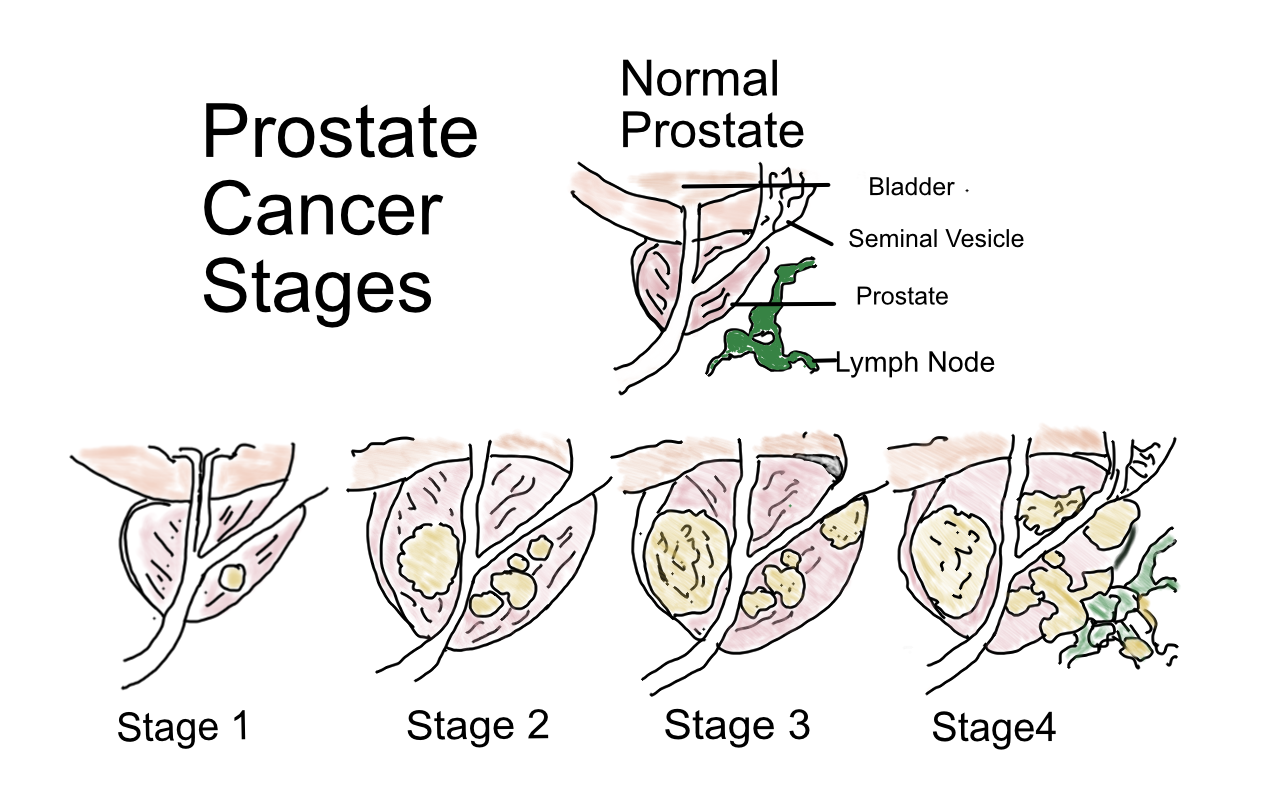
|
Grade
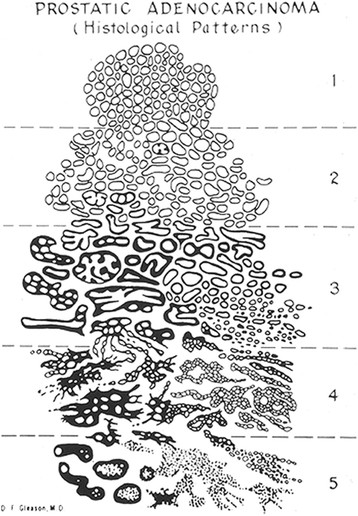 | The speed of cancer growth determines appropriate treament and is estimated by its grade. Aggressive cancers should be treated whereas slow growing and small volume cancer can be monitored over time. The speed of a cancer growth is determined initially by a cancer’s grade.The traditional way of quantifying the grade of a cancer is the Gleason scoring system. The Gleason system assigns a number to the two most common growth patterns within a cancer and those numbers are added together to create a Gleason score. The Gleason score is often represented as a simple math equation, eg. 3+4=7. Gleason score totals range from 6 (slow) to 10 (most aggressive). In 2014, the World Health Organization adopted the Grade Grouping system for assigning prostate cancer grade. The Grade Grouping System assigns a single number, 1 (slow) though 5 (most aggressive), to a cancer. Both grading systems are used today but the Grade Grouping System parallels the Gleason system but improves the grading accuracy for moderate risk Gleason 7/Grade Group 2 and 3 cancers. |
Treatment Options
Localized prostate cancer is still contained within the prostate gland and has not invaded nearby tissues nor has it spread to distant sites in the body like bones or lymph nodes. Distant or metastatic disease is when the prostate has extended beyond the prostate
Treatment options for localized prostate cancer vary depending on factors such as the aggressiveness of the cancer, the patient's overall health, and the patient’s personal preferences.
Common treatment approaches may include active surveillance (watchful waiting), surgery (prostatectomy), radiation therapy, focal ablative therapy, androgen deprivation, or a combination of these treatments.
Treatment for advanced disease requires hormonal therapy, chemotherapy, and radiation most commonly.
Treatment for prostate cancer depends on various factors such as the stage and grade of cancer, overall health, and personal preferences of the individual.
Radiation damages the cancer cells through a concentrated treatment of radiation to the prostate and the cancer cells. This is a good treatment option for men with localized prostate cancer or for men with local recurrence of prostate cancer after prostatectomy.
Focal therapy is used in limited circumstances, the cancer would need to be confined to a portion of the prostate that can specifically be identified on imaging such as MRI. There are several options that can deliver ablativ treatment to a portion of the prostate.
Hormone therapy is the standard for slowing down prostate cancer cells. Prostate cancer is sensitive to the male hormone testosterone. By reducing testosterone the cancer cells will slow their growth and may even top growing entirely and recede. Hormonal treatment are typically used for men with advanced prostate cancer but is also used in conjunction with radiation therpy.
Advanced Prostate cancer is cancer that has spread beyond the prostate to other area of the body . Unfortunately there is no cure for this type of cancer and we must focus on slowing its growth. The good news is that there are a number of treatment options that exist.
Choosing a treatment option can feel daunting. The first step is determining what options are available for your particular cancer? What is the stage and grade? Is it curable? Does it need treatment now or can it be monitored?
Next comes larger questions. What other health concerns do I have that will determine my choice of treatment? What is my expected longevity?What are my goals for my care? What is important to me?
Men with longer life expectancy and better health should be biased towards earlier treatment of the prostate cancer after initial diagnosis. Men with shorter life expectancy and multiple health concerns are better candidates for surveillance protocols or watchful waiting of their prostate cancer.
Some men will be biased towards more aggressive treatments by their personal choice or intolerance to a surveillance protocol. Some men will be more comfortable with surgery; other men will choose radiation. There is often no one right answer in each case. Because there are often alternatives, a man’s personal preferences becomes a major factor in choosing a treatment option.
daVinci Robotic Radical Prostatectomy
Radical Prostatectomy is the most common choice for treatment for men with prostate cancers that are large enough in size and growing fast enough to require treatment. Radical Prostatectomy refers to the removal of the entire prostate and the attached seminal vesicles and, in most cases, a sampling of lymph nodes within the pelvis to check for cancer spread. Although radical prostatectomy is a great choice for many, men choosing prostatectomy should be aware of the potential for urinary incontinence and erection problems that can occur after prostatectomy.
I began using the daVinci robotic techniques around the year 2008. This video I recorded in 2020 originally to introduce a video series for the VidScrip video platform. The daVinci robot has changed the way I practice and what I can offer to patients.
I am proud to be a certified robotic surgeon of excellence at United and St John’s Hospitals.
The “SIMS” Postoperative Class Video
What’s a SIMS? SIMS stands for Surgical Impotence Management Strategy. The class was originally designed as a way to educate men about the changes in erections that occur after a robotic radical prostatectomy. We began over 20 years ago at Minnesota Urology (then Metro Urology) educating men in a lecture format on a monthly basis.This page contains a video I made about the SIMS class that became a very important tool during COVID-19 and men continue to find it helpful.